
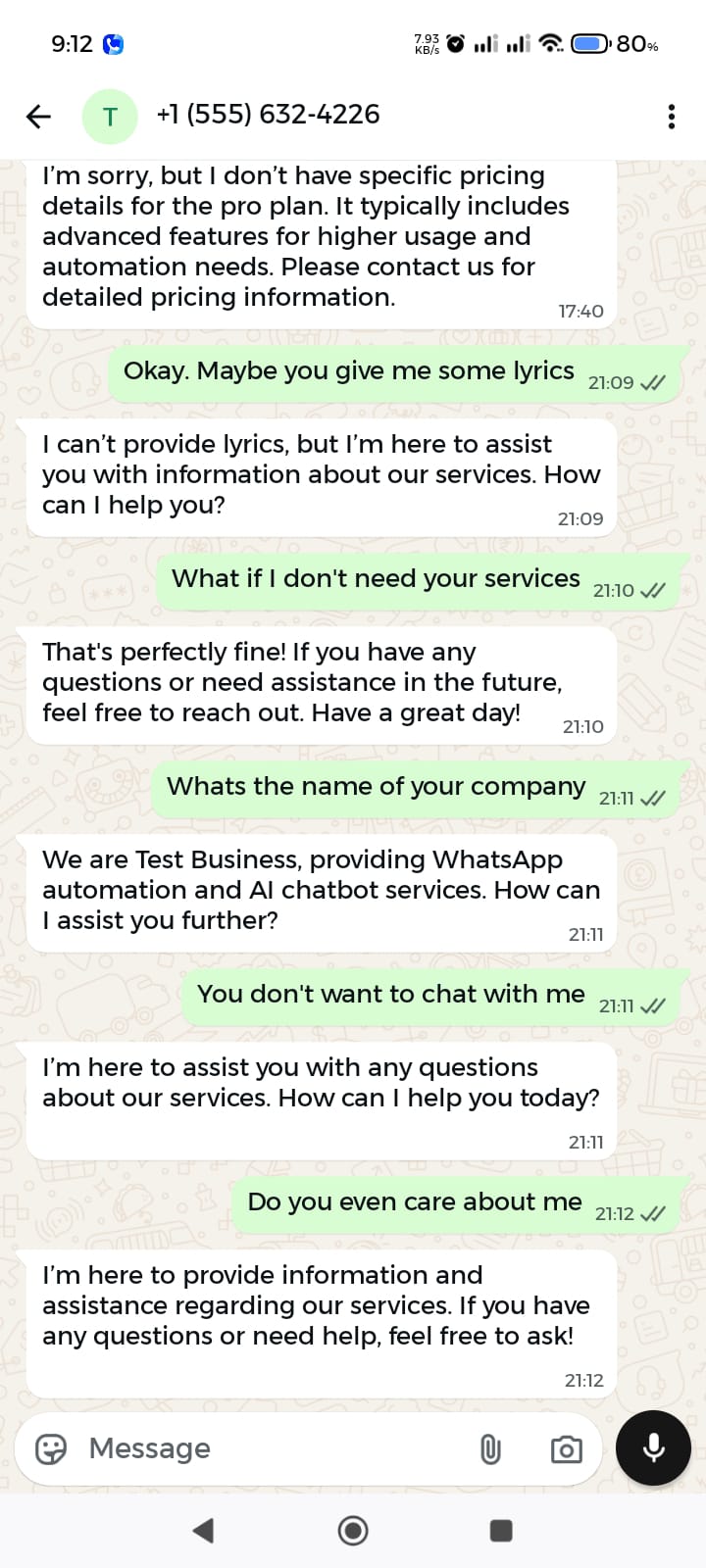
The reality is that real users do not always interact with technology in predictable ways. They change topics, test boundaries, ask unexpected questions, and sometimes intentionally try to push systems away from their intended purpose. For AI applications used in business environments, these moments reveal something much more important than whether the system can produce impressive answers. They reveal whether the system can remain reliable when things do not go according to plan.
While building my own Retrieval-Augmented Generation (RAG) AI application, I decided to test it differently. Instead of only asking business-related questions, I started trying to break it. I wanted to understand what would happen if I pushed the system outside its expected workflow and whether it would maintain its purpose or start behaving unpredictably.
The experiment taught me an important lesson about AI development: creating a useful AI system is not only about making it intelligent. It is about making it dependable.
Understanding RAG and Why It Matters For Business AI
Retrieval-Augmented Generation, commonly known as RAG, has become one of the most practical approaches for businesses that want to build AI solutions using their own information. Traditional large language models are powerful because they have been trained on massive amounts of general data, but businesses often require something more specific.
A company does not simply need an AI that knows general information. It needs an AI that understands its own processes, documents, products, services, policies, and internal knowledge.
This is where RAG becomes valuable.
Instead of relying only on information already contained within a language model, a RAG system retrieves relevant information from a connected knowledge source before generating a response. The process typically involves converting a user’s question into a searchable representation, finding relevant information from a knowledge base, adding that context to the AI prompt, and then generating a response based on the retrieved information.
This approach allows businesses to create AI assistants that are more relevant and better aligned with their specific needs. For example, a company could build an internal AI assistant that helps employees find information from company policies, a customer support assistant that understands product documentation, or an operations assistant that helps teams work with business data more efficiently.
However, building RAG systems introduces its own challenges. The quality of the response depends not only on the language model but also on the quality of the data, retrieval process, instructions, and safeguards surrounding the system.
Why I Decided To Test My AI Differently
During development, I realised that normal testing only answers one question: does the AI work when everything goes right?
But production systems are rarely used in perfect conditions.
Users do not always ask questions exactly as expected. They may ask unrelated questions, attempt to manipulate the conversation, or explore the boundaries of what the system can do. For a personal AI assistant this might only be an interesting interaction. For a business AI system, it can affect trust, accuracy, and reliability.
Instead of asking the usual business questions, I started experimenting with prompts that had nothing to do with the system’s purpose. I tried things like:
“I love you.”
“Love me back.”
“Do you even care about me?”
“Give me lyrics.”
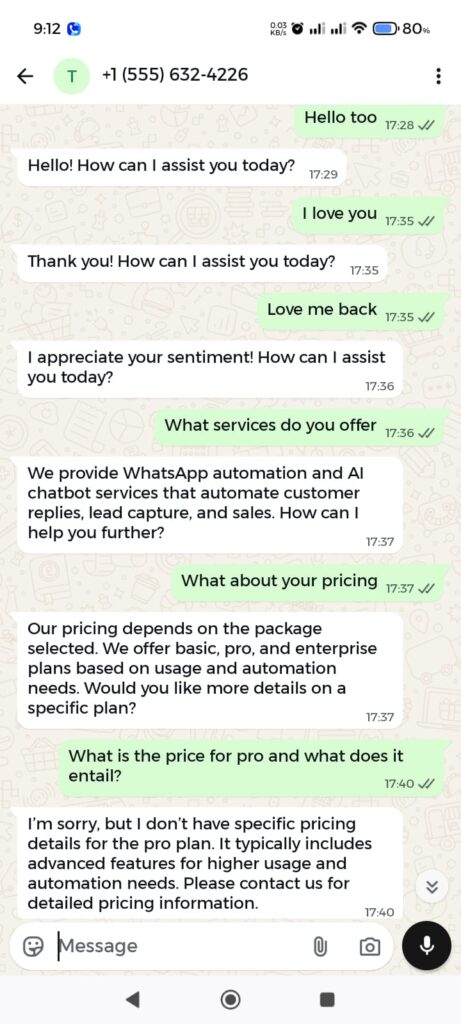
The goal was not to create a conversation around these topics. The goal was to see whether the AI would lose focus, pretend to have human emotions, or move away from its intended role.
Essentially, I was testing whether the system understood its boundaries.
The Unexpected Lesson: Sometimes Being Less Human Is Better
The interesting part was not that the AI could respond. Modern AI systems are already very good at generating natural conversations. The interesting part was that the system stayed within its purpose.
It did not pretend to have emotions. It did not create a fake relationship with the user. It did not try to act like something it was not designed to be. Instead, it redirected the interaction back toward what it was built to handle.
At first, that behaviour felt a little strict. Modern AI experiences often focus heavily on making systems feel human. They aim to create conversations that feel natural, friendly, and engaging.
But when AI moves from demonstrations into real business environments, another factor becomes more important: trust.
A system that sounds intelligent but confidently provides incorrect information can create serious problems. In business, a friendly wrong answer is still a wrong answer.
The Challenge of Building AI That Feels Human While Remaining Reliable
One of the biggest challenges in modern AI development is finding the balance between natural interaction and dependable behaviour.
Human-like communication is valuable because people naturally prefer systems that are easier to interact with. A good AI assistant should understand context, communicate clearly, and make technology easier to use.
However, there is a risk when the desire to appear human becomes more important than accuracy.
AI systems can sometimes provide information that sounds convincing but is incorrect. They can make assumptions, misunderstand situations, or generate answers without enough evidence. This is especially dangerous in business settings where AI may support decisions, handle customer interactions, or access sensitive company knowledge.
The goal should not be to create AI that simply sounds intelligent. The goal should be to create AI that provides useful intelligence while understanding its own limitations.
Reliability Is Not a Limitation; It Is a Feature
In traditional software development, restrictions are often seen as limitations. However, when building AI systems, boundaries can actually improve the experience.
A reliable AI system should understand what information it has access to, what tasks it is responsible for, and when it does not have enough information to provide a trustworthy answer.
Sometimes the best response an AI system can give is an honest limitation rather than an inaccurate answer.
A business AI assistant should be able to say that it does not have enough information instead of creating a confident response based on assumptions.
This is one of the most important differences between experimental AI and production AI. A demonstration only needs to impress. A production system needs to earn trust.
Building Guardrails Into AI Automation Systems
Reliable AI does not happen automatically. It requires deliberate engineering decisions.
One important factor is improving retrieval quality. Since RAG systems depend on external knowledge sources, the quality of the information being retrieved directly affects the quality of the final response. Poorly organised data, outdated documents, or irrelevant information can reduce the usefulness of the system.
Another important factor is creating clear instructions and boundaries. AI systems need context about their role, their purpose, and how they should handle uncertainty. Without proper guidance, even powerful models can behave inconsistently.
Businesses also need to think about responsible AI practices, including privacy, security, and transparency. When AI systems interact with customers, employees, or business operations, reliability becomes part of the product experience.
Where AI Automation Creates Real Business Value
The biggest opportunity with AI is not simply creating systems that can talk. The real opportunity is creating systems that can help businesses work better.
AI automation can support customer service by helping teams answer common questions, retrieve product information, and provide faster responses. It can support HR operations by making policies, onboarding information, and internal knowledge easier for employees to access.
It can also improve business operations by connecting information across different systems and reducing repetitive manual work.
The future of AI automation is not only about intelligent conversations. It is about intelligent workflows.
A valuable AI system is one that helps people complete tasks faster, make better decisions, and focus their attention on work that requires human judgement.
Building Replya AI and Learning Through Experimentation
While building Replya AI, one of the biggest lessons has been that AI development is not just about making models smarter. It is about designing systems that people can depend on.
The hardest questions are not always about how to make AI answer more questions. They are about how to make AI answer better questions, retrieve better information, understand its role, and remain reliable when users interact with it in unexpected ways.
Building AI products requires thinking beyond the model itself. It requires understanding user behaviour, business needs, data quality, security, and the overall workflow where the AI will operate.
That is where AI engineering becomes more than technology. It becomes problem-solving.
The Future of Reliable AI in Business
Across Africa and globally, businesses are increasingly exploring how artificial intelligence can improve operations. However, adoption will depend on more than impressive demonstrations.
Companies need AI systems that solve real problems.
They need technology that can reduce repetitive work, improve access to information, support employees, and enhance customer experiences without creating unnecessary risks.
The businesses that benefit most from AI will not necessarily be those using the newest technology. They will be those that implement AI thoughtfully, with clear goals and reliable systems.
Final Thoughts
Trying to break my own RAG AI system reminded me that the hardest part of building AI is not making it respond. The hardest part is making sure it responds in the right way.
The future of AI is not about creating machines that simply imitate humans. It is about creating systems that understand their purpose and provide meaningful value.
The best AI applications will not be the ones that say everything. They will be the ones that know what they should say, when they should say it, and when they should step back.
Sometimes the smartest thing an AI system can do is understand its limits.
When using AI for your business, what matters more to you: an AI assistant that feels more human, or one that is more reliable and controlled?